
- Events
Financing the Just City: Rethinking Urban Infrastructure Development and Democratic Participation in Africa
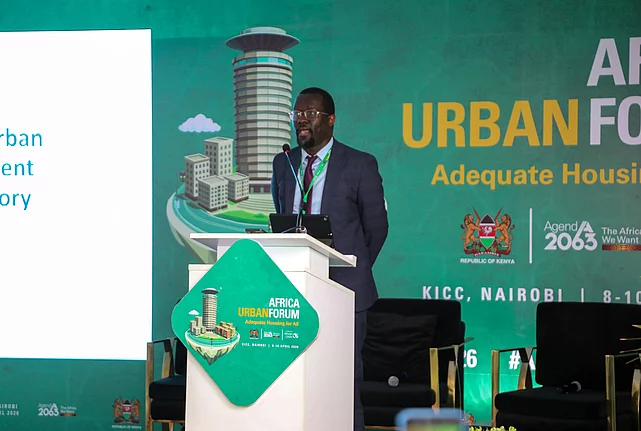
At the Second African Urban Forum (AUF2), convened at the Kenyatta International Convention Centre, the Friedrich-Ebert-Stiftung (FES) Just City Project hosted a high-level side event examining one of the most pressing challenges facing African cities today: how to finance urban infrastructure in a way that is not only effective, but also democratic, inclusive, and just.
Bringing together researchers, practitioners, and policymakers, the session explored the intersection between urban infrastructure financing and participatory democracy, drawing from new research and practical experiences across the continent.
Urban Growth and the Financing Challenge
Opening the session, Christian Denzin, the FES Tanzania Resident Director, framed the discussion within the broader context of Africa’s rapid urbanization. As cities expand at some of the fastest rates globally, the demand for infrastructure, ranging from housing and transport to water and sanitation, continues to grow. Yet, the financial systems that underpin urban development are struggling to keep pace.
Across the continent, cities face an estimated annual infrastructure financing gap of tens of billions of dollars. At the same time, traditional public financing and development assistance have declined, prompting governments to increasingly turn toward private capital and market-based solutions.
While this “private turn” in development finance promises efficiency and innovation, it also raises critical concerns about equity, accountability, and democratic participation.
Who Decides—and Who Benefits?
In his presentation, Jeremy Okonjo posed a fundamental question: who decides how African cities are built, and who ultimately benefits from these decisions?
Drawing on research conducted in collaboration with FES, he argued that infrastructure financing is not merely a technical issue, but a deeply political one. The mechanisms used to finance urban development shape not only what gets built, but also whose voices are heard in the process.
Across many African cities, the increasing reliance on private and blended financing models has shifted decision-making away from citizens and toward investors, financial institutions, and contractual arrangements. These models often prioritize profitability and risk management over social outcomes such as accessibility, inclusion, and affordability.
The result is a growing disconnect between infrastructure development and the needs of the majority, particularly low-income urban residents and those living in informal settlements.
The Limits of Participation in Current Financing Models
A central theme of the discussion was the limited space for citizen participation within existing financing frameworks. While public financing mechanisms often include provisions for consultation, participation is typically confined to informing citizens or seeking feedback, rather than enabling meaningful influence over decisions.
In private and blended financing arrangements, participation is even more constrained. Commercial confidentiality, technical complexity, and investor-driven priorities frequently limit public engagement to minimal or symbolic levels.
This reality stands in contrast to the principles of the Just City, which emphasize dignity, equity, and democratic participation as essential components of urban development.
Participatory Democracy as a Necessary Condition
The session emphasized that participatory democracy must be understood as a core requirement for just urban development, rather than an optional add-on. Moving beyond periodic elections, participatory democracy involves creating institutionalized spaces where citizens can actively shape decisions on planning, financing, and implementation.
As outlined in the presentation, meaningful participation exists along a spectrum, ranging from basic information-sharing to deeper forms of engagement such as co-production and empowerment. However, most current systems remain concentrated at the lower end of this spectrum, limiting the transformative potential of citizen involvement.
Strengthening participatory democracy is therefore essential not only for improving accountability, but also for ensuring that infrastructure investments respond to real needs and deliver equitable outcomes.
Emerging Innovations in Urban Financing
Despite these challenges, the discussion highlighted a range of innovative approaches that demonstrate the potential to align financing with democratic participation.
Examples from across Africa illustrate how alternative models can expand citizen engagement and improve accountability. Participatory budgeting initiatives in cities such as Matam in Senegal have enabled residents to directly influence how public funds are allocated, shifting decision-making power closer to communities. Similarly, the use of green bonds in Tanzania has introduced new accountability mechanisms by linking financing to specific environmental and social outcomes, monitored through independent verification processes.
In South Africa, community ownership trusts in the energy sector have created pathways for local communities to hold equity stakes in infrastructure projects, ensuring that benefits are shared more broadly. Meanwhile, community-led financing models, such as savings groups and cooperative housing initiatives, have demonstrated how grassroots actors can mobilize resources and drive development from the bottom up.
These examples underscore the possibility of reimagining financing systems to be more inclusive, transparent, and responsive to citizens.
Housing Finance and the Question of Inclusion
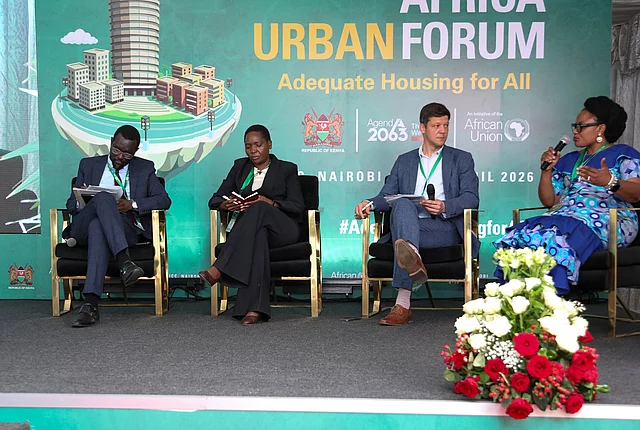
Providing reflections on the presentation, Magdalena George brought the discussion into the housing sector, emphasizing the need to focus on the people at the centre of urban development.
She highlighted that many existing financing models, particularly mortgage-based systems, fail to reach low- and middle-income populations, who constitute the majority of urban residents. In contexts characterized by informality and income insecurity, alternative approaches such as housing microfinance, community savings groups, and incremental building models are often more relevant and accessible.
Her intervention reinforced the importance of designing financing mechanisms that reflect the lived realities of urban populations, rather than imposing one-size-fits-all solutions.
Trust, Systems, and the Politics of Implementation
The interactive discussion that followed raised critical questions about trust, governance, and implementation. Participants pointed to a persistent trust deficit between communities and institutions, which continues to hinder meaningful participation and collaboration.
Others highlighted that while legal frameworks for participation often exist, they remain underutilized due to weak institutional capacity and limited public engagement. This underscores the need not only for better policies, but also for stronger systems that can operationalize participation and ensure accountability.
Concerns were also raised about the influence of external actors and financing arrangements that may prioritize external interests over local needs, further complicating efforts to embed democratic principles in infrastructure development.
Toward Inclusive and Democratic Urban Financing
The session concluded with a clear message: achieving just and inclusive cities in Africa requires a fundamental rethinking of how urban infrastructure is financed.
This includes strengthening public financing systems, democratizing private and blended finance, scaling community-led initiatives, and embedding participation in legal and institutional frameworks. It also requires building trust between stakeholders and ensuring that citizens are not merely consulted, but actively involved in shaping the future of their cities.
As Africa continues to urbanize, the choices made today about financing will have lasting implications. The challenge is not only to mobilize resources, but to ensure that these resources are used in ways that promote equity, inclusion, and democratic governance.
Through platforms such as the FES Just City Project, these critical conversations are helping to chart a path toward cities that are not only well-funded, but also just.
Watch the Replay